

Design
What happens when job search stops being a list of results and starts understanding what you actually want? We’re moving beyond keywords and filters to create an experience that learns what matters to jobseekers and gets better as they use it.

Sanjay Lal
Lead Product Designer
10 min read
24 September 2026

The challenge
Job search hasn't fundamentally changed in decades. You enter keywords, adjust filters, scroll through results and decide for yourself what's worth pursuing.
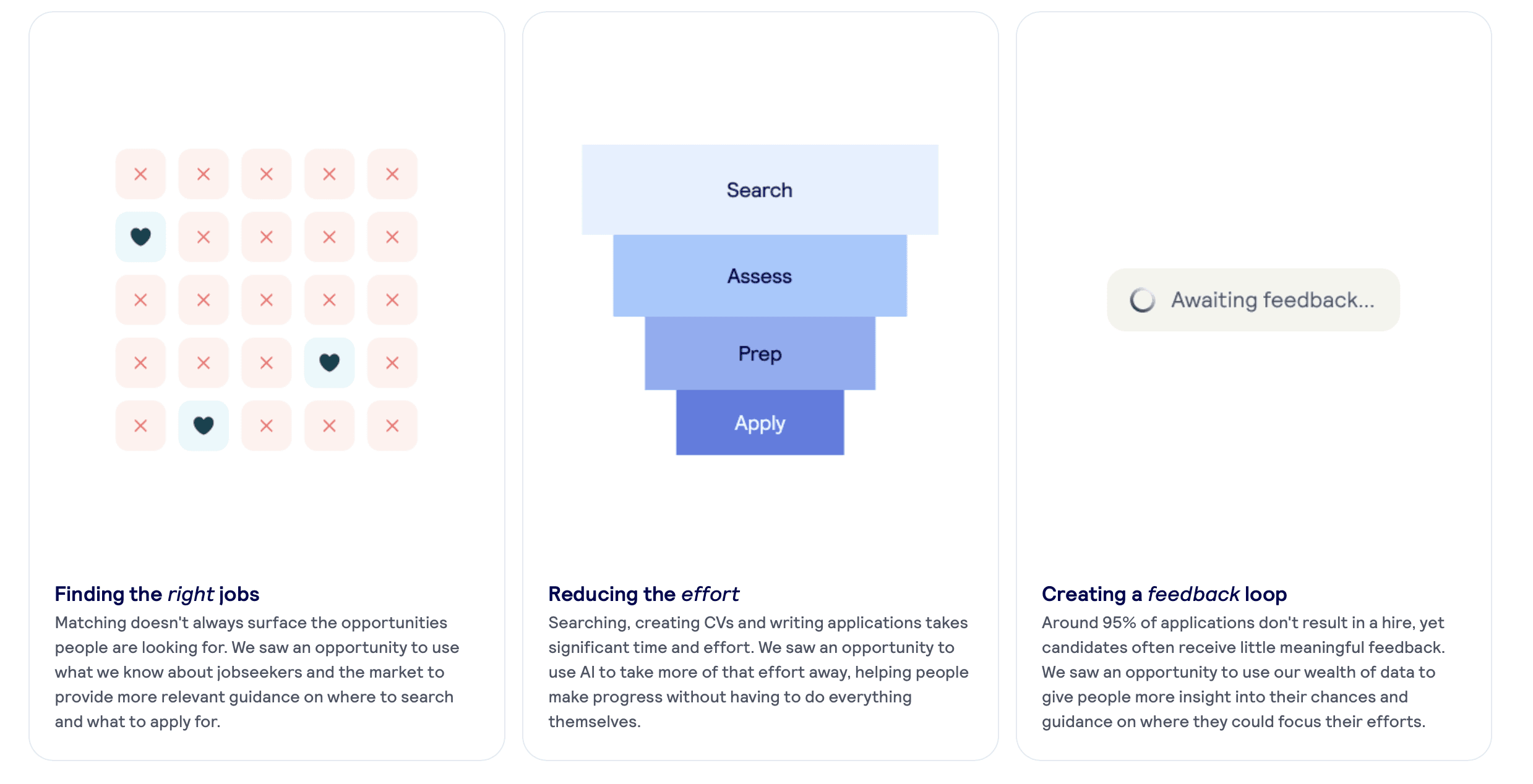
At Stepstone, we see millions of people navigate that process. We know where it breaks down: finding the right opportunities is difficult, applying takes time and effort, and most applications end without meaningful feedback.
Our challenge was bigger than improving that existing journey. We wanted to explore what AI could make possible if the experience could understand each jobseeker and adapt around them.
That gave us three fundamental problems to tackle
Bringing the vision to reality
Our ambition was clear: use AI to create a job-seeking experience that increases a jobseeker's chances of getting hired.
Our long-term vision centred around an AI Companion that could understand what someone was looking for, learn what mattered to them and actively help them move forward. But the technology needed to realise that vision wasn't going to be ready for our first releases. We had to start designing for a future that didn't fully exist yet. That raised some fundamental design questions. What should the AI do? How much control should the jobseeker have? How should recommendations work? How do we communicate uncertainty? And how should the experience evolve as it learns more about someone?
[[ INSERT VIDEO ]]
Three principles helped guide our decisions.
Clarity over complexity
AI opened up new possibilities for how people could interact with our product. But introducing new technology shouldn't mean introducing more complexity for our users. We focused on making each interaction clear and easy to understand, helping people know what's happening, why they're seeing something and what they can do next, without asking them to understand the complexity behind the scenes. The technology can be complex. The experience should feel simple.
[[ INSERT VIDEO ]]
Guidance, not just answers
We wanted AI to do more than respond to a question or return a list of jobs. It should help people make progress. That meant designing an experience that could guide jobseekers through their journey, helping them understand their options, refine what they're looking for and make more confident decisions along the way. The product shouldn't simply tell someone what to do. It should help them understand what to do next and why.
[[ INSERT VIDEO ]]
Human and approachable
Job searching can be stressful and personal. We didn't want introducing AI to make it feel more transactional. We wanted the experience to feel approachable, supportive and human, helping people feel like they were making progress rather than interacting with a piece of technology. That influenced everything from the way we structured conversations and recommendations to the language, tone and visual design.
The experience
Those principles led us to rethink some of the fundamental interactions of job search.
[[ INSERT VIDEO ]]
From conversation to action
Job searching already asks a lot from people. We didn't want adding AI to mean asking users to have another conversation, typing prompts, reading responses and working out what to do next.
Instead, we designed interactive widgets that let the AI do more of the work.
The AI Companion can speak directly to the canvas, updating the experience as the conversation progresses. Users can refine their search and see those changes reflected immediately. The conversation and the interface work together.
A smarter way to search
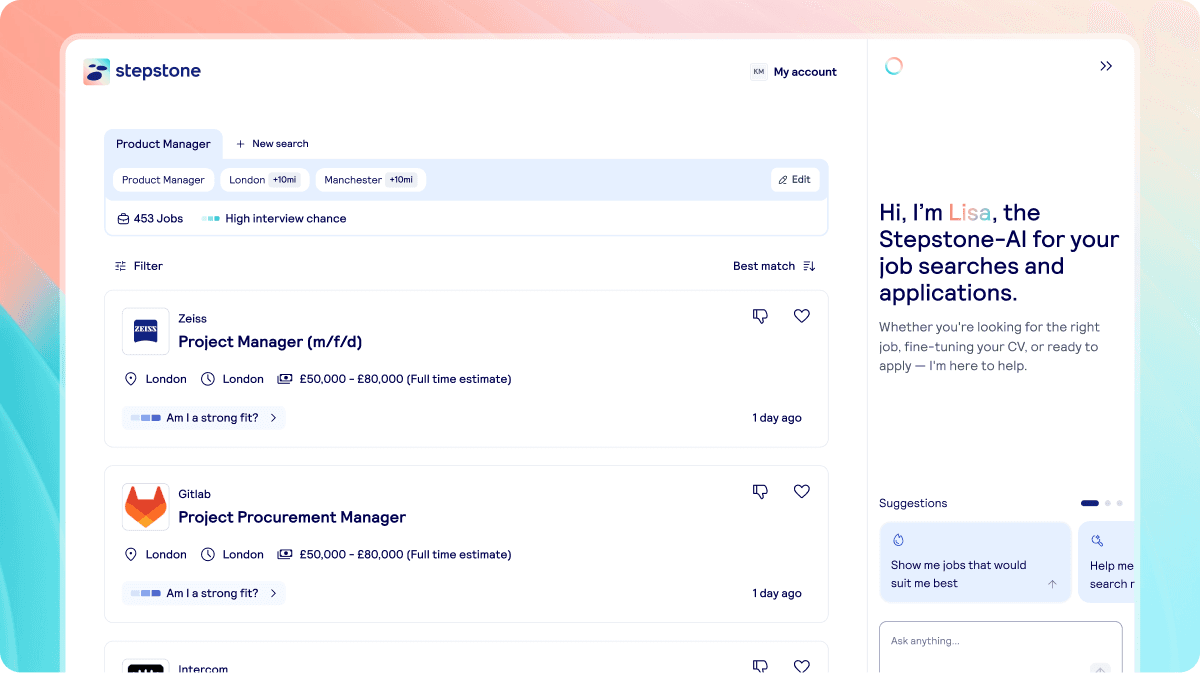
Finding the right job shouldn't mean endlessly scrolling through results. We designed a search experience that makes it easier to explore, refine and navigate opportunities, with personalised recommendations helping jobseekers discover roles they might not have found themselves.
As preferences change, the experience responds, making it easier to move between searches, refine what you're looking for and discover new opportunities without starting over.
[[ INSERT VIDEO ]]
Know your chances
By understanding more about a jobseeker's experience through their CV, we can provide a more personalised view of how well a role matches their profile and their likelihood of landing an interview. Rather than simply showing another list of jobs, we can give people more information to help them decide where to focus their effort.
Together, these experiences move job search beyond simply returning results. They make it more adaptive, more transparent and more useful, helping jobseekers understand their options and decide what to do next.
But making these ideas work was only part of the challenge. The next step was making them feel right.
The craft
Moving quickly makes it easy to focus on one question: does it work? But as the experience came together, another became just as important: does it feel right?
We worked closely with engineering throughout the build, continuously reviewing the live experience and refining the details that turn something functional into something people can trust and enjoy using.
We sweated the details: how the interface responds while AI is thinking, how recommendations appear and change, how motion connects conversation to action, how uncertainty is communicated, and how all of it translates across screen sizes.
With AI, these details aren't decoration. They're part of how people understand what the product is doing and learn to trust it.
[[ INSERT VIDEO ]]
What happens when job search stops being a list of results and starts understanding what you actually want? We're moving beyond keywords and filters to create an experience that learns what matters to jobseekers and gets better as they use it.
The beginning
Nine months in, we're still learning. The product is evolving, our ways of working are evolving, and so are we. The technology behind our AI Companion is now opening up the next chapter of the experience: searching through conversation and voice, understanding goals and preferences more deeply, and helping jobseekers move from discovering opportunities to deciding what to do next. These aren't simply new features. They have the potential to fundamentally change how people find a new job. What started as an ambitious vision is becoming a new way to search for a job. And we're only at the beginning of figuring out what that can become. For us as designers, that's the exciting part. We're not polishing a finished idea of what AI-powered job search should be. We're helping define it.
What we’re building today
When this article goes live, [TODO: clearly state what is currently live]. This is the first step towards the experience we originally imagined, and we're excited to keep learning, experimenting and pushing it forward.